


Discover
Collections, stories, featured cars and curated inventory surface the cars that deserve attention.
Discover · Editorial selection
Real live cars selected by Project Apex because they are worth a closer look — never sold as paid placement.
How Project Apex works
Project Apex helps enthusiasts find cars worth caring about, understand what makes them significant, and move from interest to a direct conversation with the right specialist seller.
Collections, stories, featured cars and curated inventory surface the cars that deserve attention.
Model context, This Specific Car, transparency and Worth Checking help explain what makes each example matter.
Buyer Intent, Buyer Demand, dealer contact and viewing requests turn interest into a direct next step.
Acquire · Live inventory
Fresh live inventory beyond the current Apex Selection.
Don’t wait for the right car to appear. Tell Project Apex what you are actually looking for. Set your must-haves, preferences, budget and timing once — then let the search keep working.
How it works
One search. Two ways to find the car.
Define the car
Set the model, budget and the criteria that actually matter to you.
Project Apex monitors
Relevant real LIVE inventory is continuously compared with your search.
You stay in control
Review explainable matches and decide if a specialist dealer may contact you.
Project Apex matches declared criteria against real live inventory. It does not generate purchase-probability scores or share your contact details without your approval.
DISCOVER BY CATEGORY

Some supercars become famous because they changed the world. Others disappear because the world was not ready to notice. The MCA Centenaire belongs to the second category. Built by Monte Carlo Automobile, the Centenaire was one of the strangest and most ambitious supercar projects of the early 1990s. Monaco is famous for hosting supercars, but rarely for building them. That alone would make the Centenaire interesting. But its real importance lies deeper: this was a road-going supercar built around a carbon-composite chassis at a moment when carbon construction was still far from normal in exotic road cars. The car now heading to Broad Arrow’s Zoute Concours Auction is chassis EL 0002 GB. According to the documentation described in the auction material, it began life as chassis 001: the first Centenaire built, used for development, testing and presentation duties before being redesignated. It was also the only example originally finished in Ivory White with red leather, a deliberate reference to Monaco’s national colours. The mechanical recipe is pure early-1990s exotic ambition. Behind the driver sits a 5.2-litre V12 from the Lamborghini Countach 5000 QV, producing 455 PS and driving through a ZF six-speed manual transmission. The car was named Centenaire to mark the 100th anniversary of the Automobile Club de Monaco and was presented to Prince Albert II in 1990. Its story is full of names that matter: Fulvio-Maria Ballabio, Carlo Chiti, Guglielmo Bellasi, Lamborghini, Monaco, Le Mans ambition and unfinished promise. The original plan was reportedly 100 cars. Reality delivered only a handful, with Broad Arrow describing three original Lamborghini-powered cars and wider development history absorbing the rest. That makes the Centenaire fascinating. It was not just obscure. It was early. Too early, perhaps. Before the McLaren F1 became the accepted carbon-road-car reference point, before boutique hypercars became an industry, before every collector understood the value of forgotten prototypes, Monaco had already tried to build its own carbon-chassis V12 supercar. Now, offered with an estimate of €900,000 to €1,200,000, the question is no longer whether people remember it. The question is whether they finally understand what it was trying to be.

For decades, the dream-car formula seemed obvious. A child’s bedroom wall needed a Countach, a Testarossa, maybe an F40 or a McLaren F1. The supercar was distant, rare and almost impossible to understand. That was the point. It belonged to another world, and the poster made that world feel close enough to touch. Today, the strange thing is that supercars are everywhere. They are not physically common, but they are visually overexposed. Every reveal is filmed, rendered, shared, reposted, argued over and forgotten within a week. Teenagers can see a McLaren W1, Ferrari F80 or Bugatti Tourbillon on a phone before most adults have finished reading the press release. The mystery has collapsed. That does not mean young enthusiasts no longer care about cars. It may mean they care differently. A Mazda MX-5, Toyota GR86, old BMW, hot hatch or lightly modified Japanese coupe offers something the modern hypercar often struggles to provide: proximity. You can imagine driving it. Modifying it. Saving for it. Seeing one at a local meet. Hearing the exhaust, touching the interior, learning its flaws, arguing about suspension and tyre choice. A McLaren may be faster. A Ferrari may be more technically advanced. But a Mazda can feel more emotionally available. That matters for car culture. Because aspiration is not only about price or performance. It is about identification. The old supercar poster worked because the car felt mythical, but still simple enough to understand: wedge shape, big engine, outrageous doors, impossible speed. Many modern hypercars are so expensive, so complex and so mediated by aero, software and brand theatre that they can feel less like dreams and more like press assets. Project Apex exists in that gap. We respect the hypercar. But we also believe the future of car culture will not be built only by million-euro machines. It will be built by cars people can feel close to. Cars with character...

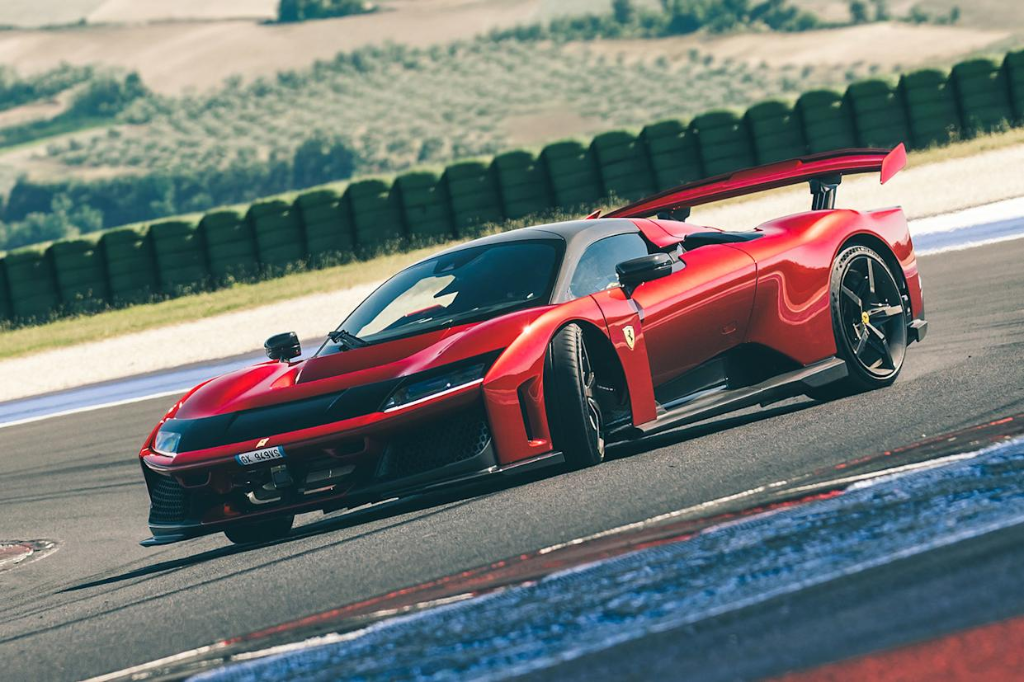
The Ferrari 296 GT Modificata is not a road car. That is exactly why it matters. Modern performance cars are often defined by what they are allowed to be. Emissions rules, road legislation, noise limits, homologation, racing regulations and Balance of Performance all shape the final machine before a driver ever turns a wheel. The 296 GT Modificata exists outside much of that pressure. It is Ferrari’s unrestricted interpretation of the 296 GT3 Evo formula, built for track use and the Club Competizioni GT environment rather than official competition. That distinction is crucial. This is not a road-going 296 GTB replacement, and it is not a homologated GT3 racer. It is something more provocative: a Ferrari track car allowed to show what the platform can do when the rulebook loosens its grip. At its heart is the 3.0-litre twin-turbocharged V6, without the hybrid system used in the road-going 296 GTB and without the restrictions imposed on the GT3 racing car. Output rises to 720 bhp and 590 lb ft, with Evo reporting that this is 128 bhp more than the GT3 car and only 100 bhp short of the hybrid road car. Ferrari has not simply turned up the boost and called it finished. Evo reports revised camshafts, intercoolers, turbochargers, a higher-flow fuel system, new ratios for the six-speed sequential gearbox and hardware influenced by the 499P programme. Aerodynamics have also been reworked, with a new centre-mounted rear wing, structural endplates inspired by the 499P, a slotted splitter, unique bonnet cooling and additional brake cooling ducts. The dry weight is listed at 1,330 kg: heavier than the 296 GT3 Evo, but substantially lighter than the road-going 296 GTB. Ferrari claims the Modificata can lap Fiorano three seconds faster than the 296 GT3 Evo in the right hands. That is the real tension. If the non-hybrid, unrestricted V6 track car feels this compelling, what exactly are road-car buyers missing?

The Aston Martin Valen is not subtle. That matters, because subtlety has never been the only reason people fall in love with a front-engined V12 Aston Martin. The appeal has always lived in the contradiction: elegance and violence, distance and danger, grand touring grace and the sense that something deeply unreasonable sits beneath the bonnet. The Valen pushes that contradiction harder. Created through Q by Aston Martin and Aston Martin’s Special Vehicle Operations, the Valen sits in the bloodline of recent limited-run Aston projects such as Victor, Valour and Valiant. But unlike the manual Valiant, this is not positioned as the purest analogue expression of the formula. It is something different: a louder, lighter and more aggressive front-engined V12 supercar built from the modern Vanquish base. The numbers are serious. Aston Martin states that the Valen uses a 5.2-litre twin-turbocharged V12 producing 850 PS and 1000 Nm. Power is sent through a retuned ZF eight-speed automatic transmission. Magnesium wheels reduce unsprung mass by 6 kg, while carbon-ceramic brakes, a titanium exhaust system and an extreme carbon-fibre visual package sharpen the car’s intent. Production is limited to 150 examples, with first deliveries scheduled for Q2 2027. But the real story is not just power. The real story is survival of character. The front-engined V12 supercar is becoming an increasingly rare idea. Modern performance is moving toward electrification, silent torque, software-managed speed and increasingly complex architectures. The Valen does not ignore that future, but it also refuses to enter it quietly. It is not as pure as a manual Valiant. It is not as elegant as a traditional DB grand tourer. It is not as clinically efficient as a modern hybrid hypercar. And that is exactly why it is interesting. The Valen sits in a narrow emotional space: too dramatic to be a normal GT, too luxurious to be a race car, too traditional to feel like the future and too extreme to feel like the past. For Project Apex, that tension is the point. Not always the cleanest solution.
Understand · Project Apex Heritage
Researched automotive history connects the machines in today’s marketplace with the people, engineering and moments that gave them meaning.

59 researched moments
An Italian automotive marque founded in 1963 in Sant’Agata Bolognese.
Explore the marque
51 researched moments
Porsche is where engineering discipline becomes emotion. From the lightweight 356 and the enduring 911 to dominant racing prototypes and electric performance, the marque has built its identity through precision, continuity and relentless technical refinement.
Explore the marque
122 researched moments
An Italian automotive marque whose first car to carry the Ferrari name, the 125 S, appeared in 1947, building on the racing activity of Scuderia Ferrari, founded by Enzo Ferrari in 1929.
Explore the marquePlus the most interesting cars with character we found that week. No generic automotive-news dump. No daily inbox clutter.